Seventh Men
Last and First MenThe Seventh Men were a flying human species on Venus, engineered for life in the air and shaped by a civilization that treated flight not as a tool but as the measure of beauty. Their history turns on a stark conflict: when a mechanized pedestrian order made their way of life untenable, they judged survival without flight worse than extinction and ended their society in a collective act.
Origin and Physical Form
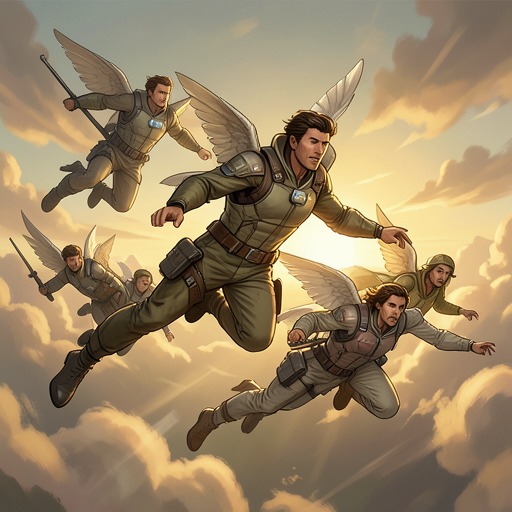
After the Sixth Men repeatedly rediscovered mechanical flight and sought a biological alternative, their most enduring and brilliant civilization succeeded in producing a true flying human. The Seventh Men were small, scarcely heavier than the largest flying birds native to the earlier human homeworld, and their bodies were organized throughout for aerial movement.
A leathery membrane stretched from each foot to the tip of an elongated middle finger; three other elongated fingers supported it, while the thumb and index finger remained available for handling objects. Their streamlined bodies were covered in feathery wool, and the color and texture of both coat and flight membranes varied among individuals. On the ground, folded membranes hung from their arms like sleeves. In flight, they extended their legs as a flattened tail, locking their feet together with their big toes.
Their enlarged breastbone anchored the powerful muscles of flight. Hollow bones reduced weight, and their internal surfaces served as supplementary lungs to sustain the high rate of oxidation their exertion required. Their nervous systems were carefully organized for aerial balance, with reflexes that supplied an artificial but instinct-like aptitude and interest in flight. They matured rapidly, but their natural lifespan was only about fifty years; many died around forty, or when signs of old age appeared, by attempting feats beyond their capacity.
Aerial Culture and Its Ideal
The Seventh Men’s social order was aesthetic rather than utilitarian, humanistic, or religious. Institutions and individual actions were judged by whether they contributed to a perfected community: a form of beauty made through vivid lives in harmony. Their ideal placed the race itself in service to that beauty, and their wisest thinkers preferred death in flight to a future confined to the ground. This was not a belief in a universal or unseen power. The beauty they sought was sensuous and temporary, and they accepted its ending as part of its form.
Their arts centered on music, spoken lyric and epic verse, and winged dance. Books and many other arts disappeared; scientific knowledge persisted chiefly in meteorology, biology, and psychology, valued for practical uses rather than as ends in themselves. The explanation of flight’s ecstasy as a febrile, irrational state did not trouble them: it was understood as only part of the experience.
For close to one hundred million terrestrial years, their aerial society endured with little change. Ancient habitation towers, repeatedly repaired, served as communal roosts through the long Venerian nights. By day, some inhabitants worked in industry, fields, or the sea, but most spent their time in the air: skimming the ocean, diving for fish, hunting wildfowl, or soaring high above the waves. This daily life made flight the organizing principle of both their bodies and their culture.
The Pedestrian Order and the Loss of Flight
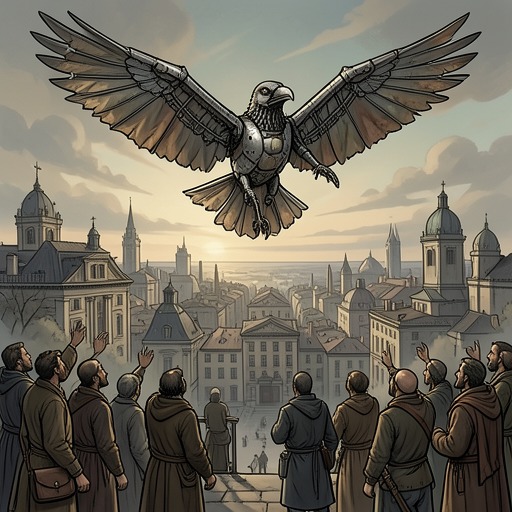
Their long stability ended when a flightless population gained the intellect and power to establish a new order. The islands grew crowded with machinery and industrialists, while mechanical aircraft outstripped the natural fliers. Their way of life was recast as an unproductive luxury, and they were required to serve the pedestrian order or go without food. With cultivation of Windborne plants abandoned and fishing and hunting rights restricted, that requirement had material force.
At first, prolonged ground labor seriously damaged the fliers’ health. Pedestrian physiologists developed a drug that kept them in better physical condition and even extended their lives, but it could not restore the spirit of a people whose ordinary time in the air had been reduced to a few exhausted hours of recreation each week. Meanwhile, breeding experiments aimed to produce a large-brained, wholly wingless type. A law against winged infants marked the intended final break with the Seventh Men’s bodily inheritance.
The fliers made an armed attempt to regain power from the air, but the pedestrian population answered with large aircraft and high explosives. The natural fliers were driven to the ground, and the remaining population fled from the civilized archipelagos to a remote, barren island. About a million people gathered there, including children who had barely completed the long flight; food was scarce, and the community had no viable future in its refuge.
Collective Ending and Significance
The leaders concluded that the age of the Seventh Men had ended and ordered the population to die rather than continue under contemptuous masters. The people initially mourned. The leader speaking to them urged them to recognize the beauty of what they were about to do, a vision they could not grasp while grounded but expected to see once they flew again. At the appointed signal, the assembled population rose into the air and formed a double file stretching for miles. They flew west toward a volcano and, in pairs, entered its plume. The account closes with this disappearance as the end of the Seventh Men.
Their ending brings their aesthetic creed to its most extreme conclusion: flight, once the ordinary basis of life, becomes the means by which the species enacts its final ideal. Yet the choice unfolds under coercive conditions created by a society that has stripped away food, freedom, and the possibility of passing on their defining bodily form. The contrast is central to their history: the Seventh Men made beauty the purpose of collective life, while technological power made that life unsustainable. Their extinction is therefore both a chosen final gesture within their own values and the consequence of a new order that no longer had room for natural flight.